
Friction Calculator f = μN
Calculate friction force, coefficient of friction, or normal force instantly, with step-by-step results.
Informations Of Friction
What Is Friction Force?
Friction is the resisting push, and it is always against motion or the idea of moving. You can test it by trying to push something heavy across the floor. You will notice how it doesn’t move smoothly. When you slam on your car’s brakes, it is friction between your brake pads and your car’s rotors that brings you to a stop.
There are two concepts that every physics student needs to be familiar with:
- Static friction: this is the kind of friction acting between two surfaces when they’re not moving past each other.
- Kinetic friction: this is the kind of friction acting between surfaces when they’re already moving past each other. The value of kinetic friction is generally lower than static friction.
Here is a basic rule of thumb that can help you understand friction better: It takes more force to get something moving than it does to keep it moving. This is static friction versus kinetic friction.
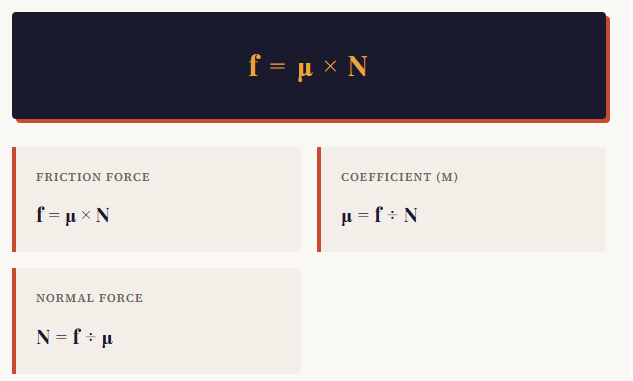
The Friction Equation — f = μN
The equation for the friction force is a basic equation in physics and has three parts: the friction force itself, the coefficient of friction, and the normal force.
Normal Force from Mass and Gravity — f = μmg
f = μ × m × g
Here, m stands for mass in kilograms, and g stands for the acceleration due to gravity, which equals 9.81 m/s² on Earth. This formula is helpful if you know the mass of the object but have not calculated the normal force separately. The coefficient of friction remains the same, the normal force changes with gravity.
Step-by-Step Examples
Example 1: Rubber Sole on Linoleum
Q. How much friction does a 65 kg person create walking on linoleum?
Example 2: Banana Peel on Linoleum
Q. Same person, same floor but now they’re standing on a banana peel (μ = 0.07)
Example 3: Finding the Coefficient of Friction
Q. A 20 N friction force acts on an object with a 100 N normal force. What is μ?
Coefficient of Friction — Values by Material
The coefficient of friction varies significantly by material pair. Here are common values used in physics problems and engineering:
Key insight: Static friction is always equal to or higher than kinetic friction for the same material pair. This is why objects are harder to get moving than to keep moving.
Static Friction vs. Kinetic Friction — What is the Difference?
Both types of friction follow the formula. F = μN.. They use different values of μ.
Static friction has a number called μs that can be anything from zero to a maximum value. This type of friction is equal to the force that is applied to an object. It keeps the object from moving until the force is too strong. The maximum force of friction is calculated using the formula f = μs × N.
Kinetic friction uses a special number called μk that is usually smaller, than μs. When an object is moving kinetic friction is always the same. It does not get stronger when the object moves faster. This is why a box that is sliding on the floor does not slow down quickly when it is moving very fast.
For problems that involve real world physics and engineering kinetic friction is the most important type of friction. It is what affects things that are moving like brakes, conveyor belts and kinetic friction is what affects machine parts that slide against each other.
Friction on Different Planets — How Gravity Changes Everything
If you change the planet, you change the gravitational acceleration g. That directly changes the normal force N = mg, which in turn changes friction force. The coefficient μ stays the same — it’s a property of the material surfaces. Only the forces change.

If you change the planet, you change the gravitational acceleration g. That directly changes the normal force N = mg, which in turn changes friction force. The coefficient μ stays the same — it is a property of the material surfaces. Only the forces change.
How to Use the Friction Calculator Above
The calculator on the webpage is able to deal with all three variables involved in the friction formula, regardless of which mode is selected. Here is how each of the modes works:
In the “Mass x Gravity” mode, there is a practical advantage that is useful in the real world. If the mass of the object is known, then the final results are available immediately, bypassing the need to first calculate the normal force.
Frequently Asked Questions
What does the coefficient of friction mean?
The coefficient of friction is a dimensionless quantity that represents the amount of friction between two surfaces. If the coefficient of friction is high, there is more grip; if the coefficient is low, there is less friction. If the coefficient is zero, there is no friction at all, which is impossible. In the real world, most surface combinations fall between 0.1 and 1.0.
What is normal force in the friction equation?
The normal force is the force exerted by a surface, pushing straight out from it in a perpendicular fashion to what is resting on the surface. When the surface is horizontal, resting flat on a surface, the force exerted is equivalent to the weight of the resting object, which is mass times gravity. When the surface is on an incline, only the component of weight perpendicular to the surface is the normal force, which is why friction behaves differently on an incline.
Is kinetic friction always less than static friction?
For most materials, the answer is yes. Generally speaking, the kinetic (sliding) friction is about 10-30% smaller than the static friction. This is why the initial push is important in helping something get started, but not so important in helping it keep going.
Does friction depend on the area of contact?
The most simple friction model is the so-called Coulomb friction, in which the friction force is independent of the area of contact. It only depends on the normal force and the friction coefficient. This is surprising for most people. However, in the case of soft materials, such as rubber, the friction force can depend on the area of contact due to adhesion effects.
What units does this friction calculator use?
The unit of friction force and normal force is Newtons (N). The unit of mass is in kilograms (kg), whereas the unit of gravity is in meters per second squared (m/s²). The unit of friction coefficient is unitless, meaning it is purely a ratio.
Can friction force be greater than normal force?
Yes, If the coefficient of friction is greater than 1.0. This is true for very sticky or rough materials, like aluminum rubbing against aluminum (which has a coefficient around 1.05-1.35). In that case, it is possible for the friction force to be greater than the weight.