
Free Fall Calculator
A free fall calculator is used to calculate how long it would take for an object to fall from a given height, how fast it would be falling when it reaches the ground, and how far it would have fallen. It uses basic kinematic equations with the assumption of no air resistance and a constant acceleration due to gravity of 9.8 m/s².
- Accelerated Aging Calculator
- Arrow Speed Calculator
- Atom to Mole Converter
- Asphalt Tonnage Calculator
- Burn Rate Calculator
- Bradford Factor Calculator
- Contribution Margin Calculator
- Carrying Capacity Model Calculator
- Cell Dilution Calculator
- Cultural Ethnicity Calculator
- Death Rate Calculator
- Drug Metabolism Calculator
- Discount Savings Calculator
- ERA Calculator
- Electronegativity Calculator
- Reverse BMI Calculator
- SCHD Dividend Calculator
What Is Free Fall ?
Free fall is the motion of an object under the influence of gravity only. In this case, the only acting force is gravity. In this ideal condition of free fall, which can also be called ideal free fall or vacuum free fall, the acceleration due to gravity is the same for all objects regardless of their masses.
This acceleration is the acceleration due to gravity and is usually denoted by the letter g. The standard acceleration due to gravity on the Earth’s surface is:
g = 9.8 m/s² (more precisely 9.80665 m/s²)
This is the phenomenon Galileo observed at the Leaning Tower of Pisa. In an ideal free fall, a cannonball and a feather fall to the ground at the same time. This phenomenon does not change even if the object is heavy or light.
However, in the real world, the effect of the drag force is felt by the falling body. In this case, the denser the body, the greater the speed. This is the reason a feather falls slowly while a coin falls rapidly.
What Is a Free Fall Calculator?
A free fall calculator is an online physics calculator that determines the missing information in a free fall problem given a known quantity, which can be the height, time, or velocity of the object in free fall. With a free fall calculator, you can get instant results for:
- Fall Time: The amount of time it takes for the object to fall to the ground
- Final Velocity: The rate at which the object strikes the ground
- Fall Distance: The distance the object travels in a given amount of time
A good online free fall calculator should be able to handle different units, provide detailed solutions, and accommodate different situations, such as an initial downward velocity or a different gravity field, like the Moon or Mars.
How Does a Free Fall Calculator Work?
You enter something you know, like height, time, or velocity, and the calculator enters that into the appropriate kinematics equations. These are the traditional free-fall equations you’ll find in any physics textbook, and they come from Newton’s second law with constant gravity.
How it works:
- Enter the known quantity (e.g., height = 50 meters)
- The calculator determines which equation to use
- The calculator solves for the unknowns (time, velocity, etc.)
- Results are displayed with units, as well as a (hopefully) detailed derivation of the steps taken
They also convert between metric (SI) units, like meters and meters/second, and imperial units, like feet and feet/second or miles/hour, so you can use them in classrooms or in the real world.
Free Fall Formulas
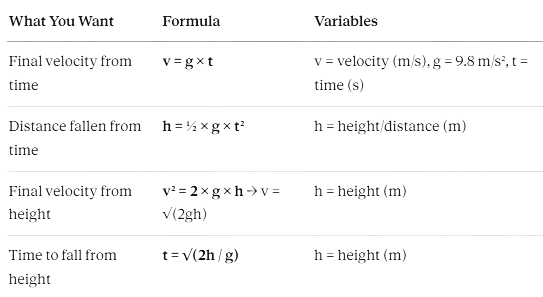
These three equations will cover any typical free fall situation. The equations assume that the object starts from rest, i.e., the initial velocity is zero, and accelerates due to a constant gravitational force.
Core Kinematic Equations for Free Fall
If There Is an Initial Velocity
If you are dropping an object downwards, but not letting it go, you need to use v₀.
- v = v₀ + g × t
- h = v₀t + ½ × g × t²
- v² = v₀² + 2 × g × h
This is important for problems like finding out how fast something will hit the ground if it was dropped from a certain height, but was not released from rest.
Gravitational Acceleration on Other Bodies
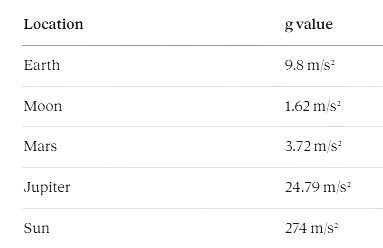
It is also important for astronomy-type problems, and some more complex free fall calculators allow you to change the gravity value for different planets.
Free Fall Step-by-Step Examples
Example 1: How Long to Fall 100 Meters?
Given: Height (h) = 100 m, g = 9.8 m/s², initial velocity = 0
Find: Fall time (t)
Formula: t = √(2h / g)
Solution:
t = √(2 × 100 / 9.8)
t = √(200 / 9.8)
t = √20.408
t = 4.52 seconds
Final velocity at impact:
v = g × t = 9.8 × 4.52 = 44.3 m/s (about 159 km/h or 99 mph)
Dropping an object from 100 meters will result in an object landing in a bit under 4.52 seconds, cruising at almost 100 miles per hour. This is why fall protection calculations are so important in construction and engineering safety.
Example 2: How Far Does an Object Fall in 3 Seconds?
Given: t = 3 seconds, g = 9.8 m/s²
Find: Distance fallen (h)
Formula: h = ½ × g × t²
Solution:
h = 0.5 × 9.8 × (3)²
h = 0.5 × 9.8 × 9
h = 0.5 × 88.2
h = 44.1 meters
In one second, it falls 4.9 meters. After two seconds, it falls 19.6 meters. After three seconds, it falls 44.1 meters. The distance is increasing in proportion to the square of time. This is uniformly accelerated motion.
Example 3: Calculate Impact Velocity from Height (50 Meters)
Given: h = 50 m, g = 9.8 m/s²
Find: Final velocity (v)
Formula: v = √(2 × g × h)
Solution:
v = √(2 × 9.8 × 50)
v = √980
v = 31.3 m/s (=112.7 km/h or 70 mph)
Example 4: Calculate How Long to Fall from 50 Meters
Given: h = 50 m, g = 9.8 m/s²
Find: Fall time (t)
Formula: t = √(2h / g)
t = √(2 × 50 / 9.8)
t = √(100 / 9.8)
t = √10.204
t = 3.19 seconds
Free Fall vs. Projectile Motion
Another related idea is projectile motion, although it is not the same.
- Free fall is moving along one vertical line, straight down.
- Projectile motion is moving both horizontally and vertically at the same time (like tossing a ball at an angle).
In projectile motion, the vertical motion follows the same equations as the motion of objects in free fall, but the horizontal motion does not have gravity pulling on it (if we don’t worry about the effect of the atmosphere). A calculator that computes the motion of objects in free fall only computes the vertical motion, while another calculator that computes the motion of objects in projectile motion computes the horizontal and vertical motion.
Real-World Applications of Free Fall Calculations
Knowing how to calculate how fast something falls and how long it takes is not only useful for schoolwork.
Engineering and safety applications include:
- Drop tests: engineers drop an item from a certain height to test how well it will hold up.
- Fall protection: safety regulations for construction sites involve knowing how much force is involved in an impact.
- Hazard assessment for a falling object: determining the danger zone for an object that is raised.
Forensic and accident-related applications include:
- Free fall accident assessment: a rough estimate of how long an object has been in motion before it hit something.
- Calculating impact velocity based on height: used in accident reconstruction.
Sports and recreation include:
- Skydiving: the speed of a skydiver’s free fall reaches terminal velocity, but the initial fall follows a different equation until air resistance is a factor.
- Bungee jumping: the initial free fall is until the bungee cord tautens.
Education and Research
- Physics problems: free fall as a core topic in high school and university kinematics
- Replications of Galileo’s free fall experiment to prove that mass does not affect falling time
- Gravity variations on different planets, comparing Earth gravity with Moon gravity for space science courses
How to Use a Free Fall Calculator — Step by Step
It is easy to use an online calculator for free-fall problems:
- Select the information you are given: height, time, or velocity
- Enter the information into the box, remembering to put in the correct units (meters, feet, seconds, etc.)
- Enter the value of gravity: on Earth, this is 9.8 m/s², but on other planets, it might be different
- Click “calculate” and the answer appears at once: time, velocity, and distance
- See the work being done: any good calculator will show you the steps, so you can follow along and learn, not just blindly repeat
Most online calculators for free fall problems do not even need you to sign up, and they work on any device, whether computer or mobile device.
FAQs
How long does it take to fall 100 meters?
Using the above equation, i.e., t = √(2h/g), if we drop an object from a height of 100 meters, assuming negligible air resistance, we can calculate that it would take about 4.52 seconds for the object to fall. The speed at which it would hit would be about 44.3 m/s or about 159 km/h. However, in practical life, air resistance would increase the time taken for the object to fall, and this time would depend on the size, shape, and mass of the object.
How fast do you fall in free fall?
Does mass affect free fall?
What is the free fall formula?
The main free fall formulas are:
- Velocity: v = g × t
- Distance: h = ½ × g × t²
- Velocity from height: v = √(2 × g × h)
- Time from height: t = √(2h / g)
Let g be the gravity on Earth, 9.8 m/s². Time, as always, is given by t (seconds). Height is given by h (meters) and velocity by v (m/s).
How far do you fall in 1 second?
With the formula for free fall given by the equation h = ½gt², an object falls 4.9 meters in the first second, 19.6 meters in two seconds, and 44.1 meters in three seconds. As you can see, the distance increases with the square of the time, which explains why free fall can get so dangerous so fast once you’re just a few meters up.