
Arrow Speed Calculator
An arrow speed calculator estimates how presto an arrow peregrination in bases per second( fps) grounded on your arc’s IBO standing, draw weight, draw length, and arrow weight. It helps hunters and bowhunters prognosticate real- world performance without demanding a bow sundial.
What Is Arrow Speed?
Arrow speed is the haste at which an arrow peregrination from the arc to the target, measured in bases per second ( fps) or measures per second (mps). It’s one of the most critical performance criteria in both bowhunting and target archery.
But raw speed is not everything. A fast arrow that is inadequately tuned or too light can be noisier, harder to control, and less effective on game. A well- matched arrow — optimized for your draw weight, draw length, and bow setup — constantly outperforms a” fast” arrow shot from a inadequately telephoned emulsion arc.
Speed matters most in three surrounds:
- Bowhunting : Arrow speed affects line, kinetic energy, and how important you need to compensate for distance.
- Target archery : Speed influences arrow drop at longer ranges like 3D archery or out-of-door FITA competition.
- Bow tuning and setup : Understanding fps helps you telephone in your emulsion bow setup and compare models from brands like Mathews, Hoyt, Bowtech, and PSE.
How Does the Arrow Speed Calculator Work?
What Is IBO Speed?
IBO speed (set by the International Bowhunters Organization) is measured under a specific standard
- Draw weight 70 lbs
- Draw length 30 elevation
- Arrow weight 350 grains
- String accessories None
The ATA speed standing (Archery Trade Association) uses slightly different conditions — 350 grains at 30 elevation but at 60 lbs. Both IBO and ATA conditions are laboratory marks, not real- world figures. nearly no huntsman shoots exactly this setup, which is why the arrow speed calculator exists.
The Arrow Speed Formula
Adjusted FPS = IBO Speed
− (draw weight reduction × 3)
+ (extra draw length × 10)
− (extra arrow weight above 350 gr × 1.5 per 50 grains)
− (string/accessory weight × 1 per 10 grains)
Each adjustment rule, explained:
Variable Adjustment
- Every 1 lb below 70 lb draw :- −3 fps
- Every 1 inch above 30″ draw :- +10 fps
- Every 1 inch below 30″ draw :- −10 fps
- Every 50 grains above 350 gr :- −1.5 fps
- Every 10 grains of string accessories :- −1 fps
This arrow speed formula works well, but it’s not an exact science. If you want an exact arrow speed, you still need a bow chronograph.
Arrow Speed Calculator: Step-by-Step Example
Let’s walk through a real-world bow hunting setup to see an example of what we’re looking like in terms of a practical application.
Setup:
- IBO speed rating: 330 fps (a pretty typical fast compound bow)
- Actual draw weight: 65 lbs (5 lbs under the IBO standard)
- Actual draw length: 28 inches (2 inches under 30″)
- Arrow total weight: 450 grains (100 grains above the 350 gr baseline)
- String accessory weight: 20 grains (D-loop, peep sight, nocking point)
Calculation:
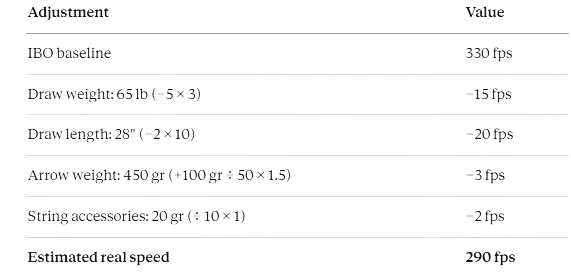
When a bow is rated at 330 fps IBO, in reality, when that bow is in a real-world hunter’s hands, its actual speed is more like 290 fps. The difference of 40 fps is the reason that the actual performance of a bow and its rated performance as indicated on the IBO chart rarely ever come in sync with each other.
Arrow Weight and Its Effect on Speed
Arrow weight, measured in grains (gr), is one of the most powerful variables you can control. A calculator can aid in understanding the interplay of speed, kinetic energy, and penetration.
Light vs. Heavy Arrows: What the Data Shows
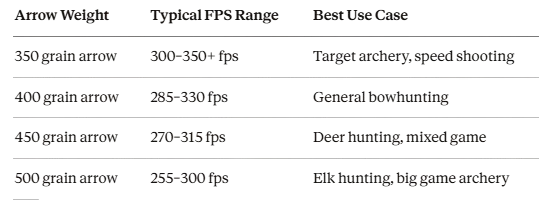
Light arrows fly faster, flatter, and require less “hold-over” at long range. Heavy arrows provide more momentum, deeper penetration, and are quieter when released. In bowhunting elk or other big game, a 500-grain arrow outperforms a 350-grain arrow in penetration, even if it doesn’t fly as fast in feet per second.
The “grains per pound” rule of thumb works for most bowhunters. We all shoot for an average of 6 to 8 grains per pound. If your draw weight is 65 pounds:
- 6 GPP = 390 grain arrow
- 8 GPP = 520 grain arrow
Arrow Weight and Kinetic Energy
Arrow speed and arrow weight, in turn, influence the arrow’s kinetic energy (KE), which is related to the arrow’s penetration capacity.
KE Formula:
KE (ft-lbs) = (Arrow Weight in grains × Velocity²) ÷ 4,50,240
Example: 450 grain arrow at 290 fps
KE = (450 × 290²) ÷ 450,240
KE = (450 × 84,100) ÷ 450,240
KE = 37,845,000 ÷ 450,240
KE ≈ 84 ft-lbs
Arrow Momentum: Why Penetration Isn't Just About Speed
Arrow momentum is a measurement unto itself, and it is arguably a more relevant measurement to bow hunting penetration than arrow speed. Kinetic energy, after all, increases with arrow velocity, but momentum is better served with heavier, slower arrows.
Momentum Formula:
Momentum (slug-ft/s) = (Arrow Weight in grains × Velocity) ÷ 2,25,400
That’s why, for example, veteran bow hunters favor a 500-grain arrow when hunting elk, rather than a 350-grain arrow. Yes, the heavier arrow loses 15% of kinetic energy, but it gains 20% more momentum, and it’s that momentum that gets a broadhead through a shoulder blade.
The kinetic energy versus arrow momentum issue remains a contentious issue in bow hunting, but as a general guideline, we can say:
- Kinetic energy is better suited to pass-throughs at moderate distances.
- Arrow momentum is better suited to deep penetration, especially when hunting game with heavy bone structures.
Draw Weight and Draw Length: How They Change Your Arrow FPS
Draw Weight Effect on Speed
A one pound change in draw weight will change the velocity by approximately 3 fps. While this may not seem like much, it can add up to quite a bit. For example, the differences are as follows:
- A 70 lb draw weight vs. a 60 lb draw weight: A 30 fps difference
- A 70 lb draw weight vs. a 50 lb draw weight: A 60 fps difference
As far as deer hunting, a 60 pound draw weight with a well-tuned compound bow and a 400 grain arrow will give you plenty of kinetic energy to make ethical shots out to 40 yards. Chasing after the maximum draw weight to gain IBO fps is one of the most common mistakes made and is often the cause of poor form and missed shots.
Draw Length Effect on Speed
Draw length affects your speed significantly. You lose 10 feet per second per additional inch. If you’re drawing at 28 inches instead of 30 inches, you’re losing 20 feet per second. This is why archers with a long draw length think their bows are fast. This isn’t just a feeling. This is physics.
It is simple math. A long draw length equals a long power stroke. This gives you more time to accelerate your arrow. You get more power stored in your bow from a heavier draw weight. You get more power stored from a long power stroke.
FOC (Front of Center): Balance Affects Arrow Flight
FOC (Front of Center) is a term used to describe the amount of arrow weight located in the front half of the arrow shaft. The balance point of the arrow plays a significant role in the stability, accuracy, and penetration of the arrow.
FOC Formula:
FOC% = ((Balance Point from nock − Half Arrow Length) ÷ Total Arrow Length) × 100
If you are using an arrow with a high FOC, it is likely to fly steadily, pack a strong punch, and is therefore ideal for bowhunting, where deep penetration is a must. However, it is also likely to be slower, and you may have to adjust your bow configuration to a compound bow.
When it comes to a complete arrow setup calculator, not only is the arrow speed (in fps) important, but also the arrow FOC and balance point itself.
Recurve, Longbow, and Crossbow Speeds
Recurve Bow Speed
When comparing recurve bow speeds to compound bow speeds, the former tends to be slower. This is mainly due to the fact that recurve bows do not have let-off or a cam system to efficiently store energy. The speed at which arrows are shot from a recurve bow normally ranges as follows:
- Olympic recurve bow: 140-170 fps
- Traditional/longbow: 130-160 fps
Even though the arrow speed calculator for recurve bows requires the draw weight and arrow weight, the IBO standard does not apply to the calculation. The calculation for recurve bow speeds may be done in a simpler way, focusing on efficiency.
Crossbow Speed
When making a crossbow speed calculator, the process is similar to that of creating a compound bow speed calculator. The speed at which crossbows shoot arrows normally refers to the speed when a crossbow fires a 400-grain bolt at a given draw weight. The fact that crossbow bolts are shorter and heavier compared to arrows affects the path and speed at which the bolt travels.
The speed at which crossbows normally shoot arrows ranges between 300-400+ fps.
Frequently Asked Questions
What is a good arrow speed for bow hunting?
For bow hunting, the majority of bow hunters spend most of their time in the range of 260-310 fps. When bow hunting deer, it is recommended to go past the speed of 260 fps with an arrow that weighs between 400 and 450 grain for a clean and ethical shot that is within a distance of 40 yards. It is not necessary to go past the speed of 330+ fps for bow hunting, and the only factor that is important is the point of impact.
How accurate is an arrow speed calculator vs. a chronograph?
A bow speed calculator may be able to provide an estimate of feet per second within 5 to 15 fps of an actual reading from a chronograph, depending on just how efficient the bow is and just how well it has been tuned. While it’s a great tool for planning, the bow chronograph remains the only tool capable of providing an exact reading.
Does draw weight or arrow weight affect speed more?
A draw weight change moves the draw speed 3 feet per second per pound, and arrow weights change speed 1.5 feet per second for every 50 grains over 350 grains. Where the differences are large, draw weights become more significant, but when comparing the arrow weights typically used for hunting, like 400- versus 450-grain arrows, arrow weights become a more significant change in day-to-day bow tuning.
What is the fastest arrow speed ever recorded?
The fastest arrow velocities recorded in official tests reach beyond 400 feet per second with the use of speed bows and the maximum legal draw weight. The best arrow velocities recorded by the best compound bow hunting setups from major manufacturers such as Mathews, Hoyt, PSE, and Bowtech reach only around 340-370 feet per second in official tests.
How do I increase my arrow speed?
Here are some steps you can take to punch up your bow speed without changing your bow: (1) increase your draw weight if your form can handle it, (2) use a lighter arrow. A weight drop from 450 to 350 grain can provide a notable increase in fps, (3) increase your draw length if your form can handle it, (4) reduce weight from your bow’s accessories like a lighter D-loop or peep sight, and (5) make sure your bow is well-tuned to avoid wasting power on arrow oscillation.