
ERA Calculator
What is ERA?
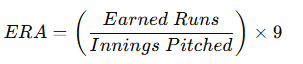
The Earned Run Average (ERA) is a common standard for evaluating pitchers. Every pitcher who pitches an inning is given their ERA based on how many earned runs they allow during the inning(s) they pitched. Therefore, ERA is simply the earned runs allowed divided by the total number of innings pitched multiplied by nine.
What is ERA Calculator?
An ERA Calculator (Earned Run Average) is often referenced as a way to determine the pitcher’s performance as reflected in his performance over many games.
An ERA calculator can look at a pitcher’s earned run average (ERA) over several games and, therefore, provide you with an accurate measure of that performance, since ERAs across innings pitched or over the course of a season are standardized in order to facilitate this comparison between various pitchers.
ERA Calculator is frequently utilized in MLB analytical studies, fantasy baseball analyses and coaching evaluations, and helps to evaluate the effectiveness of the pitcher at preventing runs from being scored when playing under “defense independent” conditions as described by the official rules of baseball scoring.
ERA fundamentally answers a single question:
The number of earned runs that a pitcher permits on average over the course of nine innings.
Because it is such a widely utilized metric for assessing pitcher effectiveness, ERA is commonly utilized in many of the major leagues to provide data representations of the pitcher performance such as:
1. The MLB earned run average leaderboards.
2. Analytics
3. Statistics for fantasy baseball.
4. Various measures for evaluating pitchers.
5. Sabermetric calculations (data).
6. Other statistical ranking of pitchers.
The calculator of baseball earned run average is used by:
1. Coaches analyzing and assessing pitching performance.
2. Players reviewing data/creating own measures or models to assess their performance.
3. Analysts doing research on pitching statistics.
4. Fans will compare historical performance instances based on ERA.
5. Scouts reviewing historical performances trends related to ER
How Does ERA Calculator Work?
The ERA computing tool also meets MLB’s required specifications. The criteria consists of the following:
a. Only earned runs (ER) are considered for the calculation of ERA.
b. No unearned runs (i.e., weather caused by fielding misplays, passed balls) should be included in the ERA calculation.
c. An ERA Calculator is calculated to a standard of 9-innings (a regulation baseball game).
The basic formula for computing an ERA is:
Step One (divide ER by Innings Pitched) = ER/Innings Pitched
Step Two (multiply step one by 9).
Step Three (round to two decimal places).
This method accurately allows a more accurate comparison among all different pitchers with different number of innings pitched.
Variables Explanation For ERA Calculator
Understanding each input data is necessary to arrive at an accurate ERA.
Earned Runs (ER)
Earned runs are defined as all runs scored except the runs scored on an error or passed ball (EPB). ERP are determined by the official scorer by determining whether or not the run scored was an earned run.
What Counts in the ERA Calculation
1. Runs scored via a hit.
2. Runs scored via a walk.
3. Runs scored via a home run.
4. Runs scored via a legal advance on throw.
What Doesn’t Count in the ERA Calculation
1. Runs scored via a fielding error
2. Runs scored via a passed ball.
3. Runs scored via a defensive misplay.
This difference is part of the reason that ERA vs RA is typically a comparison made when looking at historical baseball statistics.
Innings Pitched (IP)
Innings pitched are recorded in thirds:
| Outs | Innings Format | Decimal Conversion |
|---|---|---|
| 1 out | 0.1 | 0.333 |
| 2 outs | 0.2 | 0.667 |
| 3 outs | 1.0 | 1.000 |
Most users will need to use an Outs to Innings Converter or IP to decimals to calculate partial innings ERAs.
ERA Formula
Formula Breakdown Table
| Variable | Meaning | Description |
|---|---|---|
| ER | Earned Runs | Runs scored without fielding errors |
| IP | Innings Pitched | Total innings thrown (including partial innings) |
| 9 | Regulation Game Factor | Standard MLB game length |
Step-by-Step ERA Calculation Example
Example 1: Basic ERA Calculation
- Earned Runs = 6
- Innings Pitched = 18
- ERA=(6÷18)×9
- ERA=0.333×9
- ERA=3.00
The pitcher’s ERA is 3.00.
Example 2: Partial Innings ERA Calculation
- Earned Runs = 5
- Innings Pitched = 7.2
Convert 7.2 innings:
7 innings + 2 outs
2 outs = 0.667
Total IP = 7.667
ERA=(5÷7.667)×9
ERA=5.87
The accurate ERA calculator handles partial inning ERA automatically.
What Is a Good ERA?
ERA benchmarks vary by league and season.
MLB ERA Average (Modern Era)
| ERA Range | Rating |
|---|---|
| Below 2.00 | Elite |
| 2.00–3.00 | Excellent |
| 3.00–4.00 | Good |
| 4.00–5.00 | Average |
| Above 5.00 | Poor |
In Major League Baseball, the average earned run average has typically been between 3.80 and 4.50 for most seasons, although individual seasons will vary based on the trends of that year and offensive performance.
Years of ERA data also reflect these changes because of:
1. The Dead Ball Era
2. The Steroid Era
3. Changes in Rules
4. Changes in the Composition of the Baseball.
ERA vs Other Pitching Metrics
Modern baseball analytics compare ERA with advanced pitching stats.
| Metric | Measures | Difference from ERA |
|---|---|---|
| WHIP | Walks + Hits per Inning | Focuses on baserunners |
| FIP | Fielding Independent Pitching | Removes defensive impact |
| ERA+ | Adjusted ERA | Accounts for league & park factors |
| BABIP | Batting Average on Balls in Play | Defense-influenced stat |
| WAR | Wins Above Replacement | Total player value |
| K/9 | Strikeouts per 9 innings | Strikeout efficiency |
| BB/9 | Walks per 9 innings | Control metric |
Why ERA Matters
ERA is an important statistic in many aspects.
1. A team’s Pitching/ERA Rating
2. A team’s Pitching/ERA Ranking
3. A team’s Pitching/ERA Leaderboard Statistics
4. A team’s Fantasy Baseball ERA Statistics
5. A team’s Statistical Benchmarks for Pitchers
6. A team’s Baseball Performance Statistics
ERA can tell an analyst:
- How well a pitcher can prevent runs
- How consistent a pitcher is
- How effective a pitcher has been overall.
But as analysts have pointed out: a Team’s Defense can play a major role in calculating a pitcher’s ERA. Because of this, sabermetrics tools will often compute values for ERA against FIP.
ERA in MLB & Historical Records
Here are a few of the more memorable ERA records:
- The lowest ERA in Major League Baseball history is 0.86 (Dutch Leonard, 1914)
- The best ERA for a pitcher in the modern era is usually around 2.00 or lower.
- ERA statistics can vary from season to season depending on the trend in offensive production.
- The development of ERA has been affected throughout the years because of:
- The expansion of Major League baseball franchises
- Modifications made to playing rules
- Adoption of the designated hitter rule
- Modification of strike zone regulations
New MLB statistical tools utilizing Statcast ERA data provide greater context for ERA measures.
How to Use ERA Calculator Online
A free ERA calculator tool typically requires:
- Enter earned runs.
- Enter innings pitched.
- Click calculate.
- View ERA instantly.
Features may include:
- Mobile ERA calculator
- Printable ERA calculator
- Baseball stat converter
- Baseball analytics calculator
- IP to ERA converter
A professional ERA calculator ensures:
- Accurate decimal handling
- Instant calculation
- Up-to-date MLB ERA standards
- Beginner-friendly interface
How ERA Is Used in Baseball Analytics
ERA contributes to:
- Pitching performance analysis tools
- Coaching statistics tools for baseball
- Player ERA statistical analysis tools
- Basic Metrics for baseball performance calculator tools.
- Free MLB calculator tools for metrics.
- Comparisons of types of baseball statistics tools.
- Sabermetric scoring calculator systems.
In most analytic areas where ERA is measured, it is also combined with:
1). Pitcher Performance Metric systems
2). Baseball Scoring Metric systems
3). Advanced ERA definitions/metrics
4). Other Pitcher Performance metrics
Official References & Statistical Authority
ERA is defined and maintained by:
- Major League Baseball Official Rules
- MLB Statistical Glossary
- Baseball-Reference statistical database
- FanGraphs analytics definitions
- Society for American Baseball Research (SABR)
These authoritative sources ensure ERA calculation methods remain standardized across leagues.
People Also Ask For ERA Calculator
1. What does ERA mean in baseball?
ERA is the acronym for Earned Run Average and is the measurement of a pitcher’s earned runs per nine innings pitched.
2. How is ERA calculated?
ERA Calculator is calculated by dividing earned runs, by innings pitched, and then, multiplying that by nine.
3. What is a good ERA in baseball?
In Major League Baseball, ERA of 3.00 or less is very good, while the league average is generally in the 3.80 to 4.50 range.
4. Does team defense affect ERA?
Yes. As ERA includes the plays that fielders make (but do not include errors), therefore the way the players play their positions can indirectly affect the pitcher’s ERA.
5. How does ERA compare to FIP?
“ERA” is a measurement of earned runs given up by the pitcher, while, “FIP” is a calculation that estimates how well the pitcher pitched on his own without regard for defense.