
Codon Usage Calculator
| Codon | Amino Acid | Count | Frequency (%) | RSCU |
|---|
What is Codon Usage?
Codon is a three character code made up of three letters (nucleotides) in the DNA or RNA which encode a specific amino acid during the process of producing proteins. The three-character genetic code is composed of 64 potential codons which can specify 20 distinct amino acids along with the stop codon.
Not all organisms utilize the 64 codes equally this difference in using codes is known as codon usage bias.
A codon usage calculator or codon frequency calculator provides a numerical analysis of how often every codon is used within a protein coding region (CDS) or within a genome.
Key Concepts in Codon Usage
Understanding codon usage will help you better understand the concept of codon usage bias (the unequal preference for a particular codon among synonymous codons which all specify the same amino acid) and how it can impact the function of your genes.
Examples of codon usage bias include the following:
- Usage of synonymous codons
- Frequency of usage of synonymous codons
- Bias in choosing synonym codons
- Selecting synonymous codons based on preference
- Locating synonymous codons
Patterns of codon usage yield what is known as a codon usage profile for a gene or genome.
Codon Frequency and Distribution
A codon frequency analyzer calculates:
- Codon count
- Codon occurrence frequency
- Codon frequency statistics
- Codon distribution statistics
- Codon frequency table
- Codon usage frequency table
These metrics reveal the codon usage pattern of a gene sequence.
Codon Usage in Different Organisms
Codon preferences vary by species. Examples include:
- Human codon usage
- Bacterial codon usage
- E. coli codon usage table
- Yeast codon usage calculator
- Mammalian codon usage analysis
Understanding species codon usage is essential for gene expression optimization.
How This Calculator Works
A DNA codon usage calculator or FASTA codon usage calculator performs automated sequence codon analysis using several steps.
Step 1: Sequence Input
he tool accepts sequence data such as:
- DNA sequence input calculator
- FASTA sequence analyzer
- Gene sequence input tool
- DNA file codon analyzer
- Sequence upload analyzer
The nucleotide sequence parser reads the sequence and identifies every triplet codon.
Step 2: Codon Identification
Each nucleotide triplet is matched with the genetic code translation table using a codon translation tool or DNA codon translator.
Tools used include:
- Codon to amino acid calculator
- RNA codon translator
- Codon decoding calculator
- Codon interpretation tool
Step 3: Codon Frequency Calculation
The Codon usage calculator counts how often each codon appears using:
- Codon count calculator
- Codon occurrence calculator
- Codon frequency analysis
- Codon frequency modeling This produces
- codon frequency statistics and an analysis of codon distribution.
Step 4: Codon Bias and Index Metrics
Analyzer programs calculate index statistics associated with codon statistics (codon usage) include:
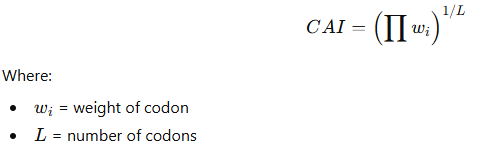
- Codon Adaptation Index (CAI)
- Relative Synonymous Codon Usage (RSCU)
- Effective Number of Codons (ENC)
- Codon Bias Index
- Codon Frequency Index
- Codon Usage Index
- Codon Optimization Index
Indices are used to calculate codon bias estimates, measure codon bias, and evaluate translation efficiency.
Formula
Several formulas are used in codon usage statistics and codon bias statistical tests.
1. Codon Frequency Formula

Used for:
- codon frequency calculation
- codon frequency statistics
- codon usage frequency table
2. Relative Synonymous Codon Usage (RSCU)

RSCU helps measure:
- synonymous codon usage pattern
- synonymous codon ratio
- synonymous codon statistics
3. Codon Adaptation Index (CAI)
Codon Frequency Calculation Examples
Example 1
DNA Sequence:
ATG GAA GAA TTT GAA
| Codon | Count |
|---|---|
| ATG | 1 |
| GAA | 3 |
| TTT | 1 |
Total codons = 5
Frequency of GAA:
3/5=0.6
This indicates a preferred codon usage for that amino acid.
Example 2: Codon Bias Analysis
A gene sequence analyzer processes a protein coding sequence and finds:
| Codon | Frequency |
|---|---|
| AAA | 0.35 |
| AAG | 0.65 |
Both encode lysine.
This shows synonymous codon preference toward AAG.
FAQs
What is a codon usage calculator?
A. A codon usage calculator is a tool used to examine and analyze codon frequency, usage bias and synonymous distribution of codons in either a DNA or RNA sequence.
How do you calculate codon frequency?
A. The calculation of the frequency for each codon is determined by dividing the total occurrences of each codon by the total number of codons present in either the gene or entire genome.
What is codon usage bias?
What is RSCU in codon analysis?
A. Relative synonymous codon usage (RSCU) calculates whether codon is being used significantly more or less than expected compared to the frequency of occurrence of all synonymous codons.
Why is codon optimization important?
A. Codons are optimized to improve gene expression, protein production, and translational efficiency, etc., by exchanging rarely used codons for codons used by the host’s optimal one.