
Buffer Capacity Calculator
Results
Informations Buffer Capacity
What Is a Buffer Capacity Calculator?
A Buffer Capacity Calculator is a scientific tool used to determine how strongly a buffer solution can resist changes in pH. It calculates how much acid or base must be added to shift the pH of a buffer by a specific amount. This measurement is known as buffer capacity (β) and is essential in chemistry, biochemistry, pharmaceuticals, environmental testing, and analytical laboratories.
The Buffer Capacity Calculator supports multiple related concepts, including:
- Acid buffer capacity
- Base buffer capacity
- Buffer index
- pH buffer capacity
- Weak acid and strong acid buffer capacity
- Weak base and strong base buffer capacity
These features make the tool useful for students, researchers, and professionals who work with buffer systems.
How This Calculator Works
A Buffer Capacity Calculator uses standard acid–base equilibrium principles to compute how much strong acid or strong base is required to cause a measurable change in pH.
Users typically input:
- Concentration of the acid form (HA)
- Concentration of the base form (A⁻)
- Total buffer concentration
- Volume of the buffer solution
- Initial pH
- Desired change in pH (ΔpH)
- Type of titrant (acid or base)
- The tool then applies formulas used for:
- Acid–base buffer capacity
- Buffer resistance
- Buffer strength
- Henderson–Hasselbalch calculations
The result indicates how effectively the solution can maintain pH stability.
Formula for Buffer Capacity
The general formula for buffer capacity is:
β=ΔpH/ΔB
Where:
- β = buffer capacity
- ΔB = moles of strong acid or base added per liter
- ΔpH = observed change in pH
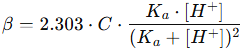
For weak acid/conjugate base systems, an extended formula is used:
Where:
- C = total buffer concentration
- Ka = acid dissociation constant
- [H⁺] = hydrogen ion concentration
This formula provides more precise results for chemical, biochemical, and laboratory work.
Step-by-Step Manual Calculation
Example Problem
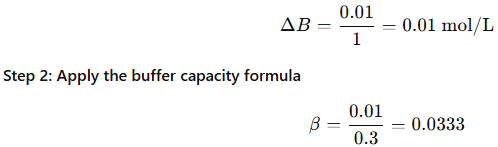
A buffer contains:
- 0.20 M acetic acid (HA)
- 0.20 M acetate (A⁻)
- Volume = 1 L
- Added acid = 0.01 mol HCl
- Observed pH change = 0.3
Step 1: Calculate ΔB
FAQs
What does a buffer capacity value indicate?
Which factors affect buffer capacity?
Concentration, pH relative to pKa, and the ratio of acid to base all influence buffer strength.
Is buffer capacity the same as buffer range?
No. Buffer Capacity Calculator measures resistance, while buffer range refers to the pH window where the buffer is effective.
Why do labs need buffer capacity calculations?
What units are used for buffer capacity?
It is reported in mol·L⁻¹·pH⁻¹, representing moles of acid or base per liter per pH unit.